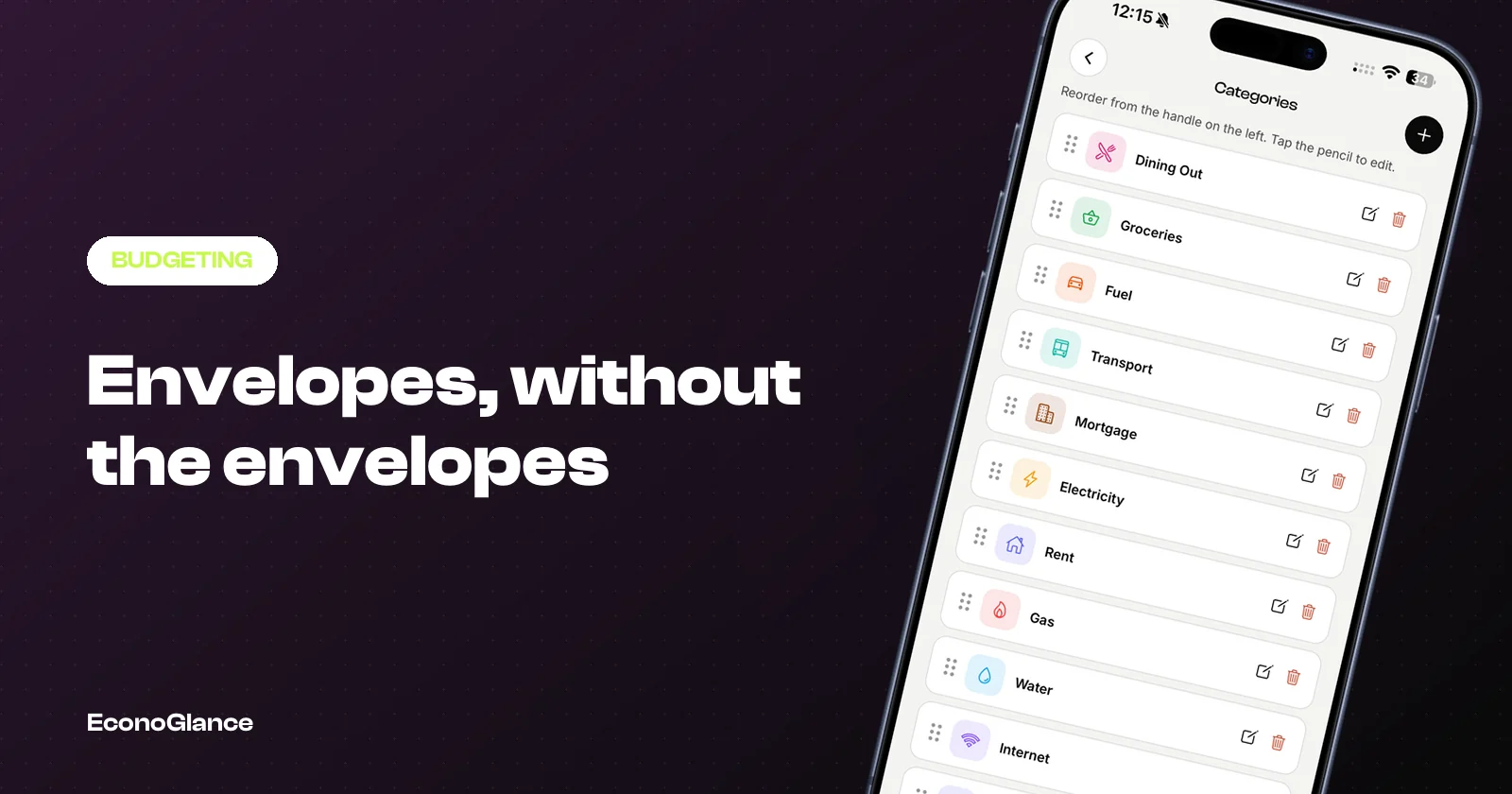
The envelope method is the oldest budgeting system that actually works. Put cash in labelled envelopes at the start of the month. When the food envelope is empty, you have finished buying food.
It works because the limit is physical and immediate. The interesting question is which part of that survives when the money is on a card.
What actually makes it work
Three mechanisms, and only one of them requires cash.
- A limit set in advance, when you are calm rather than at the till
- A visible remaining balance, so you always know where you stand
- A hard stop, so the decision is already made when the money runs out
Cash provides all three automatically. Digital can provide the first two easily and the third one never, because your card will keep working. That is the whole design problem.
Pick four to six envelopes
This is where most digital attempts fail before they start.
People create twenty categories because the app allows it, then discover that classifying every transaction into twenty buckets is a part time job. The system collapses within a month.
| Envelope | Typically covers | Rough share of discretionary spend |
|---|---|---|
| Food and groceries | Supermarket, corner shop | 35 to 45% |
| Eating out | Restaurants, takeaway, coffee | 15 to 25% |
| Transport | Fuel, transit, taxis | 10 to 15% |
| Fun | Cinema, hobbies, nights out | 15 to 20% |
| Everything else | Haircuts, gifts, the unclassifiable | 10% |
Fixed costs like rent and utilities do not need envelopes. They are not decisions you make weekly, so putting them in the system adds admin without changing behaviour.
Replacing the hard stop
Since your card will not decline, you need a substitute for the empty envelope.
The honest options, in order of how well they work: a separate account or card per envelope, which genuinely stops you; an alert when a category hits its limit; or a rule you agreed with yourself in advance.
Most people land on alerts plus a rule. The rule matters as much as the alert, and it needs deciding now rather than in the moment.
- Empty envelope means stop until next month, and the freezer gets used
- Or, borrow from another envelope explicitly and accept that one is now smaller
- Never: quietly overspend and tell yourself you will make it up
Borrowing between envelopes is fine as long as it is deliberate. The failure mode is not borrowing, it is borrowing without acknowledging it, which turns the whole system into decoration.
The daily glance
Cash envelopes report their status every time you open your wallet. Digital ones report nothing unless you look.
So the habit is the system. Ten seconds a day, checking what is left in the two or three envelopes you actually spend from. Without that, you are not doing envelope budgeting, you are doing retrospective accounting.
Per category budgets with a visible remaining figure are the digital equivalent, and a per day safe-to-spend number is the closest thing to the feeling of a thinning envelope. Both are in the EconoGlance Personal space, covered in a monthly expense tracker system.
Rolling over
Decide whether unspent envelope money carries into next month.
Rolling over rewards restraint and helps with lumpy costs like a quarterly bill or a bigger shop. Resetting each month keeps the numbers simple and stops one envelope quietly hoarding.
The usual answer is to roll over surplus but never carry a deficit forward. Carrying overspend into the next month compounds and makes the following month feel impossible, which is how people quit.
Give it two months
The first month of any envelope system is a measurement exercise, not a success.
You will set at least two categories wrong, because you do not currently know what you spend. Adjust at the end of month one and judge the system on month two. Quitting after a first month that went over is quitting before the system has told you anything.