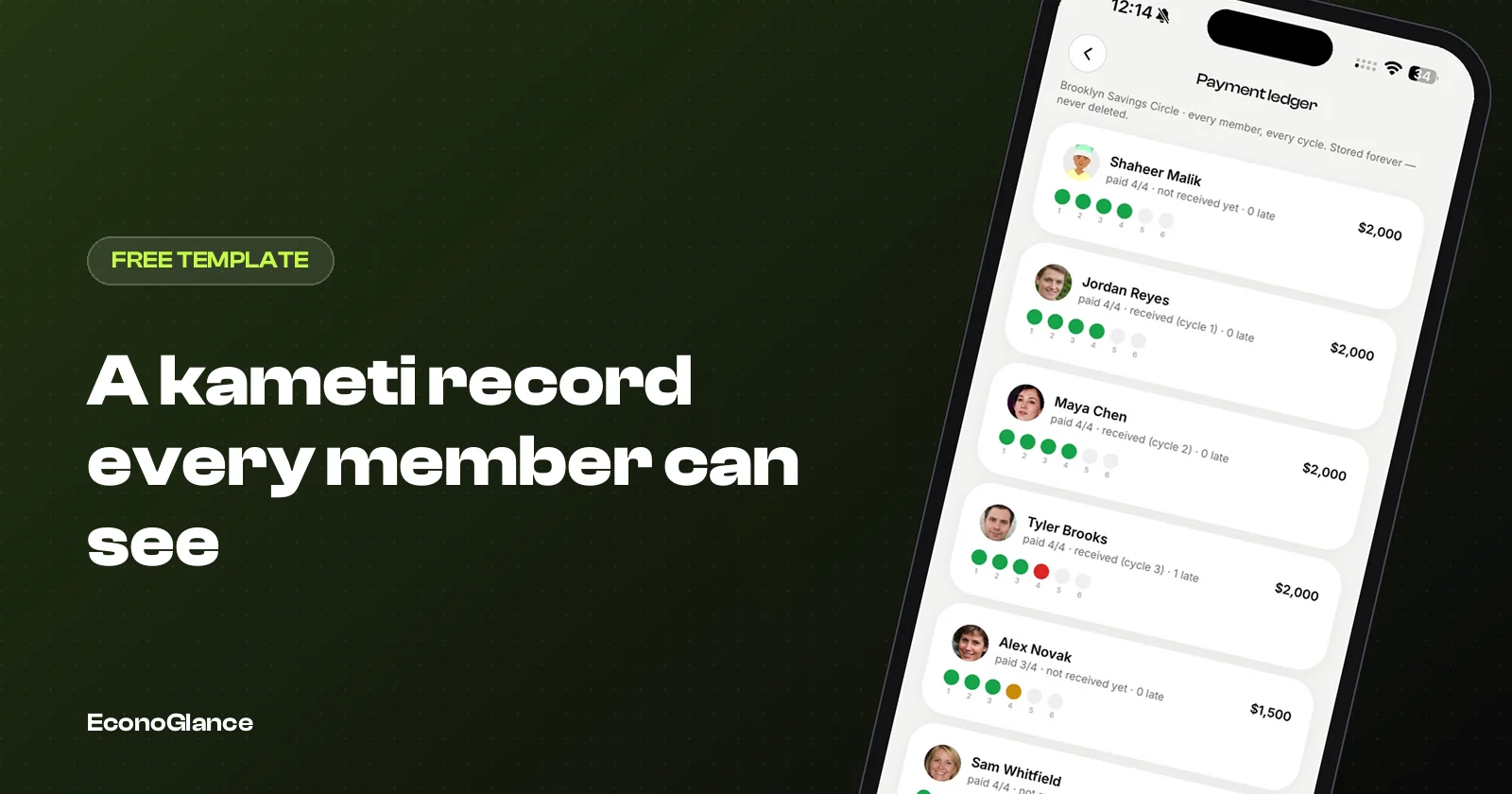
A kameti record is the written log of who is in the committee, how much each person pays, who has paid each month and who has received the pot. It is the single thing that settles almost every dispute, and most committees do not have a proper one.
The usual record is a notebook kept by the organiser. It works until the organiser is busy, loses the notebook, or remembers a payment differently from the member who made it. The fix is not complicated. It is a clear template that every member can see.
Two pages: the agreement and member list, then a 12-month payment grid and payout log. Works for up to 12 members.
What the template includes
Four sections, in the order you fill them in.
| Section | What goes in it | Why it matters |
|---|---|---|
| Agreement | Amount, frequency, start date, number of members, how turns are decided, late rules | Settles the questions people argue about later |
| Members | Name, phone, turn number, signature | Proves who agreed to what |
| Payment grid | One row per member, one column per month, ticked when paid | Shows exactly who is behind |
| Payout log | Month, recipient, amount, date, received-by signature | Proves who has already been paid |
How to fill it in
Do it at the first meeting, with everyone present.
- Write the agreement first: contribution, frequency, start date, total members and the payout method.
- Agree how lateness is handled: a grace period, and whether there is a late fee.
- List every member with their phone number. Ask each to sign beside their name.
- Fill in the turn order if it is fixed. If turns are drawn, leave the column empty and fill it each month as names are drawn.
- Take a photo of the completed first page and send it to every member the same day.
If you are unsure which payout method to use, read the guide to kameti payout order. It compares fixed turns, a draw and bidding with worked examples.
Keeping the payment grid honest
The payment grid is where records usually go wrong, and almost always for the same reason: payments are ticked from memory.
- Tick a payment the day it arrives, with the date, not just a tick.
- Write P for paid, L for late and a number for a part payment.
- If someone pays in cash, write who received it. Cash handed to a family member of the organiser is a common source of confusion.
- If someone pays by bank transfer, keep the transfer screenshot with the record.
| Member | Jan | Feb | Mar | Apr |
|---|---|---|---|---|
| Ayesha | P 01/01 | P 01/02 | P 02/03 | L 09/04 |
| Bilal | P 01/01 | P 03/02 | 10,000 | |
| Sana | P 02/01 | P 01/02 | P 01/03 | P 01/04 |
In the example above, anyone can see that Bilal paid half of March and nothing yet in April, and that Ayesha's April payment was late. Nobody has to remember anything.
The payout log
The payout log records each time the pot changes hands.
For every round, write the month, the recipient, the amount, the date and how it was paid. Then ask the recipient to sign or reply in the group chat confirming they received it. A one-line confirmation in writing prevents the most damaging kind of dispute, the claim that a member was never paid.
Five mistakes that break a kameti record
Each of these has ended a committee that was otherwise going well.
- Recording the month a payment was for, but not the date it arrived. A payment for March made in April is a late payment, and the record should show it.
- Netting payments against the pot. When a recipient 'keeps' their own contribution instead of paying it in, the record stops adding up. Record every payment in full, then the full payout.
- Letting a family member of the organiser collect without writing it down. Cash that passes through two people needs two lines.
- Changing the turn order by phone. Swaps are fine. Unrecorded swaps are how two people end up expecting the same month's pot.
- Keeping the only copy. If the organiser's notebook is lost, the kameti has no history. A photo sent to the group after every round fixes this for free.
A quick self-check at the end of every round: the total paid in that round should equal the number of members times the contribution, minus any agreed shortfall. If it does not, find out why before the next draw, not after.
Paper, spreadsheet or app?
Each format has a place, and the template works in the first two.
| Format | Good at | Weak at |
|---|---|---|
| Printed record | Signatures, meetings, members who prefer paper | Only one copy, easy to lose, no reminders |
| Shared spreadsheet | Everyone sees the same numbers, free | Anyone with edit access can change history |
| Kameti app | Reminders, every member's own view, automatic totals | Every member needs the app |
Many groups use two together: the printed agreement with signatures, plus a digital record for the monthly payments. That keeps the formality of paper and the visibility of a shared record.
Running the same record in EconoGlance
EconoGlance's kameti feature is the template above, kept up to date automatically.
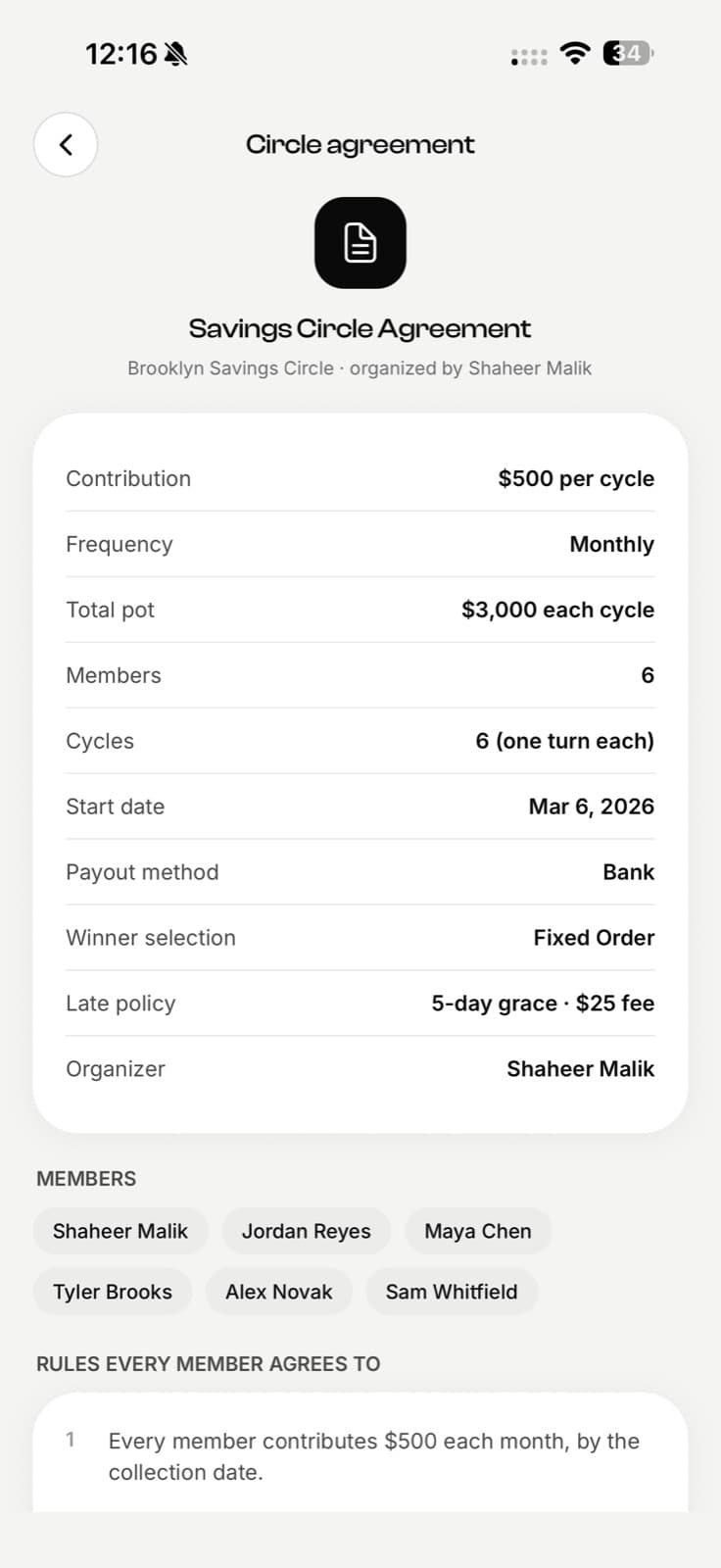
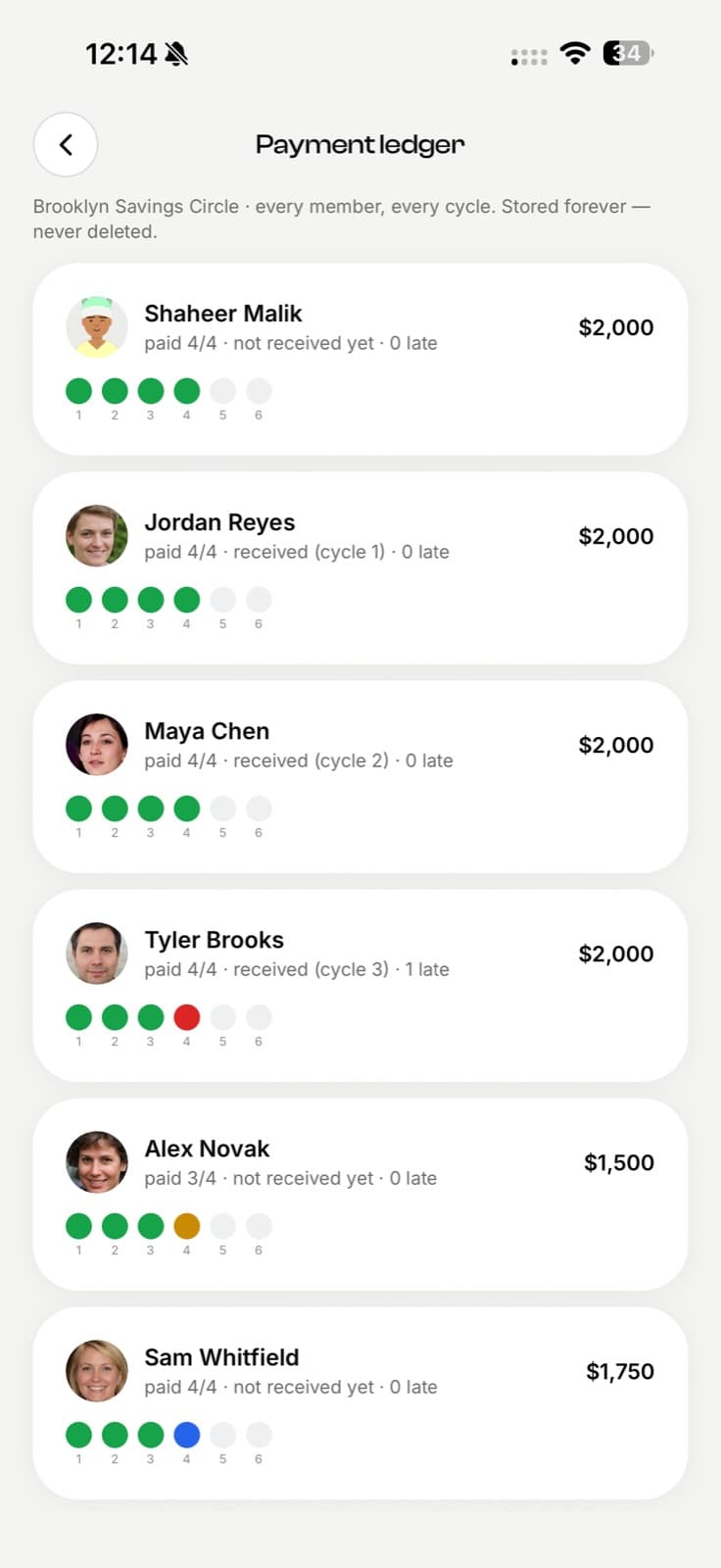
The circle agreement holds the amount, frequency, payout method and late rules, and every member can view it or export it as a PDF. The payment ledger shows each member's payments by round with paid, pending, late and part-paid marked, and members can see their own status without asking the organiser.
Organising one circle is free. For the rules that make the record work, read the kameti rules that prevent every common dispute, and to plan the pot and turns use the savings circle calculator.