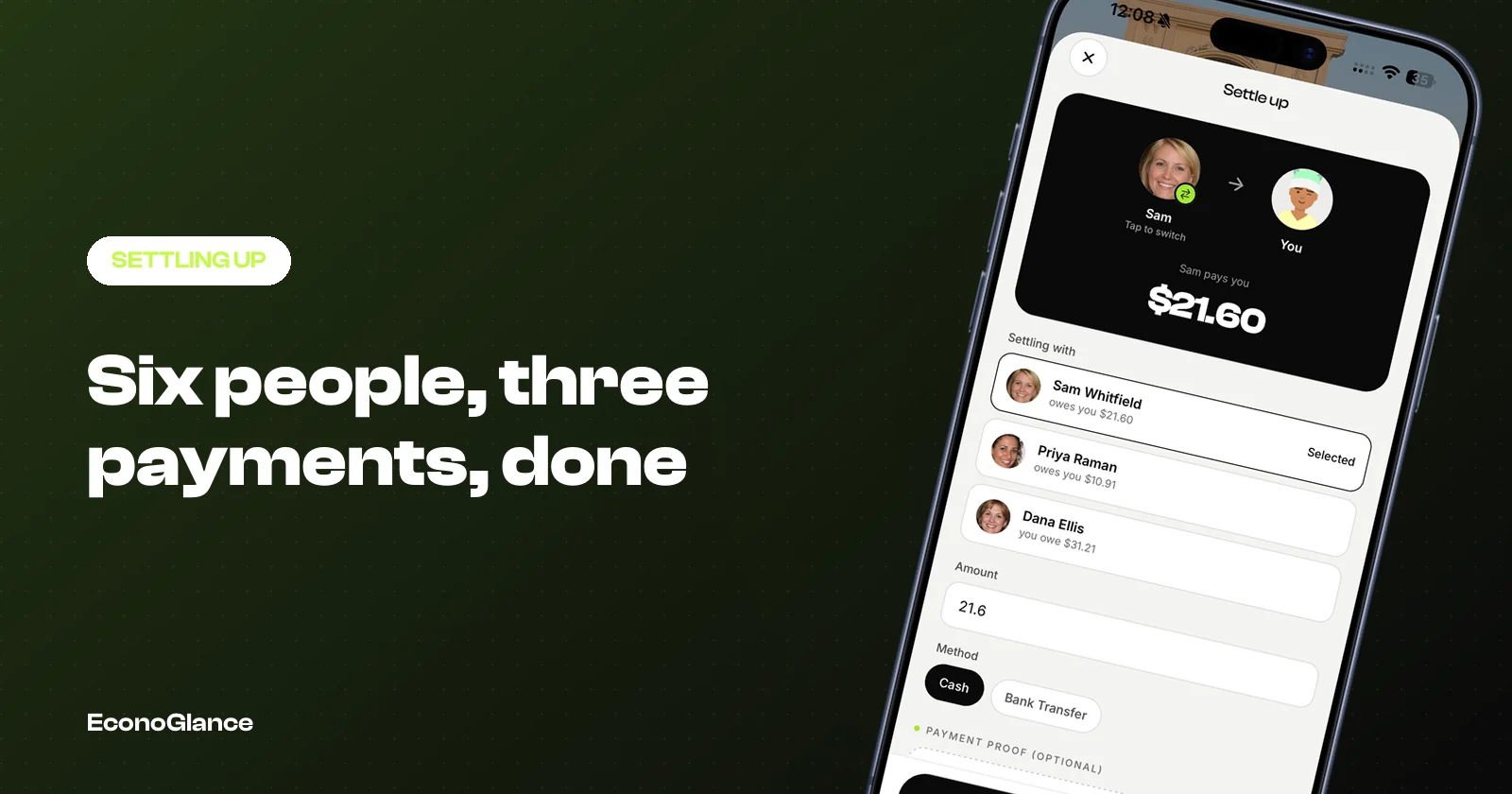
After a weekend away, a group of six can easily owe each other in eleven different directions. Nobody wants to make eleven bank transfers.
The good news is that almost all of it cancels out, and most groups can clear everything with two or three payments.
How debt simplification works
The principle is netting. If Ana owes Ben 20 and Ben owes Cleo 20, Ana can simply pay Cleo and both original debts vanish.
Scale that across a group and the number of transfers drops dramatically. The amounts each person is up or down do not change, only the routing. That is worth saying out loud to your group, because people are sometimes suspicious that simplification is doing something to their balance.
| Without simplification | With simplification | |
|---|---|---|
| Payments needed | 11 | 3 |
| Total money moved | Higher, money passes through people | Only the net amounts |
| What each person ends up with | Identical | Identical |
| Chances someone forgets one | High | Low |
The one downside: simplified payments can look odd. You may be asked to pay someone you never directly bought anything with. It is worth explaining once, because it looks like an error the first time it happens.
When to settle
Pick a trigger and stick to it. Groups that settle on a rhythm never have the awkward conversation.
- Housemates: monthly, on a fixed date near payday
- Trips: on the last evening, while everyone is still together
- Regular friend groups: whenever anyone crosses a threshold you agreed, say fifty
- Couples: monthly, or not at all if finances are genuinely joint
The trip one matters most. Settling on the final evening, in person, with everyone present, resolves in ten minutes what otherwise becomes a three week group chat with people slowly going quiet.
How to ask without it being awkward
The discomfort almost always comes from making it personal. Keep it administrative.
"I have settled up the trip, everyone should have a figure in the app" is a status update. "You still owe me 40 from Lisbon" is a confrontation, even when said kindly. The first one lets people act without feeling accused.
If someone does not pay after that, a single direct message is fine. If they still do not, the honest read is usually that they cannot rather than will not.
That case needs a different approach, which we covered in what to do about friends who never pay you back.
Record it immediately
The single biggest cause of broken group balances is a payment made in real life and never recorded in the app.
Someone hands over cash, everyone agrees it is sorted, and three weeks later the app still says they owe it. Now the record and reality disagree, and nobody remembers which is right.
Record the settlement at the moment it happens, not later. If you are handed cash, log it before you put your phone away.
Keep proof for anything large
For small amounts, trust is enough. For anything that would actually annoy you to lose, attach evidence.
A screenshot of the transfer confirmation, attached to the settlement, ends every future question in one tap. This matters most with people you do not know well, in groups formed for one event, and in any circle involving larger sums.
EconoGlance lets you attach payment proof to a settlement and notifies the other person that it is recorded, so both sides see the same thing. There is more on the mechanics in splitting expenses on a group trip.
A short checklist
Before you call a group settled, run through these.
- Every expense is in, including the small ones people forgot
- Anyone who paid in cash has had it recorded
- The balances are simplified so the payment count is minimal
- Everyone has actually sent their payment, not just seen the number
- Large payments have proof attached