
To collect money for a group gift without chasing people, choose one person to collect, set a fixed amount or suggested range, give a clear deadline and one way to pay, and put all four in the first message. Buy the gift once the money is in, or agree in advance how a shortfall is covered. Afterwards, share the total collected and what the gift cost.
The first message does most of the work
Most chasing happens because the first message left something open.
- What the gift is for, and roughly what you plan to buy.
- The amount: a fixed figure, or a suggested range.
- The deadline, a specific date a few days before you need to buy.
- How to pay: one method, with the details.
- Who is collecting, so questions go to one person.
Example: 'We're getting Aisha a weekend away for her 30th. £25 each, by Friday the 12th, by bank transfer to me (details below). I'll buy it on Saturday and share the total.' Nobody needs to ask a follow-up question.
Fixed amount or suggested range?
It depends on the group.
| Fixed amount | Suggested range | Any amount | |
|---|---|---|---|
| Best for | Close friends, family | Workplaces, mixed groups | Large groups, charity-style gifts |
| Strength | Simple, fair, easy to track | Lets people give what they can | No pressure at all |
| Weakness | Can exclude people on tight budgets | Needs a bigger buffer | Hard to plan the gift |
At work, use a range or 'any amount' and make it explicitly optional. A junior colleague should never feel that their manager knows they gave less. Collecting privately, without a public list of who gave what, matters more at work than anywhere else.
Surplus and shortfall
Decide what happens in both cases before you collect.
- Surplus: add it to the gift, buy a card and flowers, or refund it equally. Say which in the first message.
- Shortfall: buy a cheaper gift, or the organiser asks the group for a small top-up. Never quietly cover it yourself and then resent it.
- Late payers: after the deadline, one friendly reminder, then buy with what you have.
Workplace collections
Office gifts, for leaving colleagues, new babies and weddings, have their own etiquette.
- Keep contributions private. Use a sealed envelope or individual transfers, never a public list.
- Make it clear it is optional, and that signing the card is welcome either way.
- Avoid collections from the same people every few weeks. Some teams agree a small fixed amount per occasion.
- Never ask more senior people to contribute more. Let them choose to.
Family gifts
Joint gifts from siblings for a parent's anniversary or Eid are usually larger and more emotional.
Agree the gift and the amount per sibling on a call first, then let one person buy. If siblings earn very different amounts, splitting by income or letting the higher earners contribute more is reasonable, as long as it is agreed openly rather than assumed.
The income-based method is explained in how to split bills by income.
What works for different occasions
The right approach changes with the occasion and the group.
| Occasion | Typical approach | Watch out for |
|---|---|---|
| A friend's milestone birthday | Fixed amount, one experience gift | Choosing something only the organiser would like |
| A colleague leaving | Optional range, card for everyone to sign | Pressure on junior staff |
| A new baby | Optional range, a practical gift or voucher | Duplicating what others already bought |
| A wedding | Fixed amount among close friends, or a cash gift | Different cultural expectations about cash |
| Parents' anniversary or Eid | Fixed or income-based share among siblings | Assuming everyone can give the same |
Being transparent afterwards
A short message after the gift is bought closes the loop.
'Collected £225 from 9 people, the weekend away cost £210, the extra £15 went on flowers.' That one line answers every question anyone was too polite to ask, and it makes people happy to contribute next time.
Doing it in EconoGlance
For friends and family, an app removes the chasing.
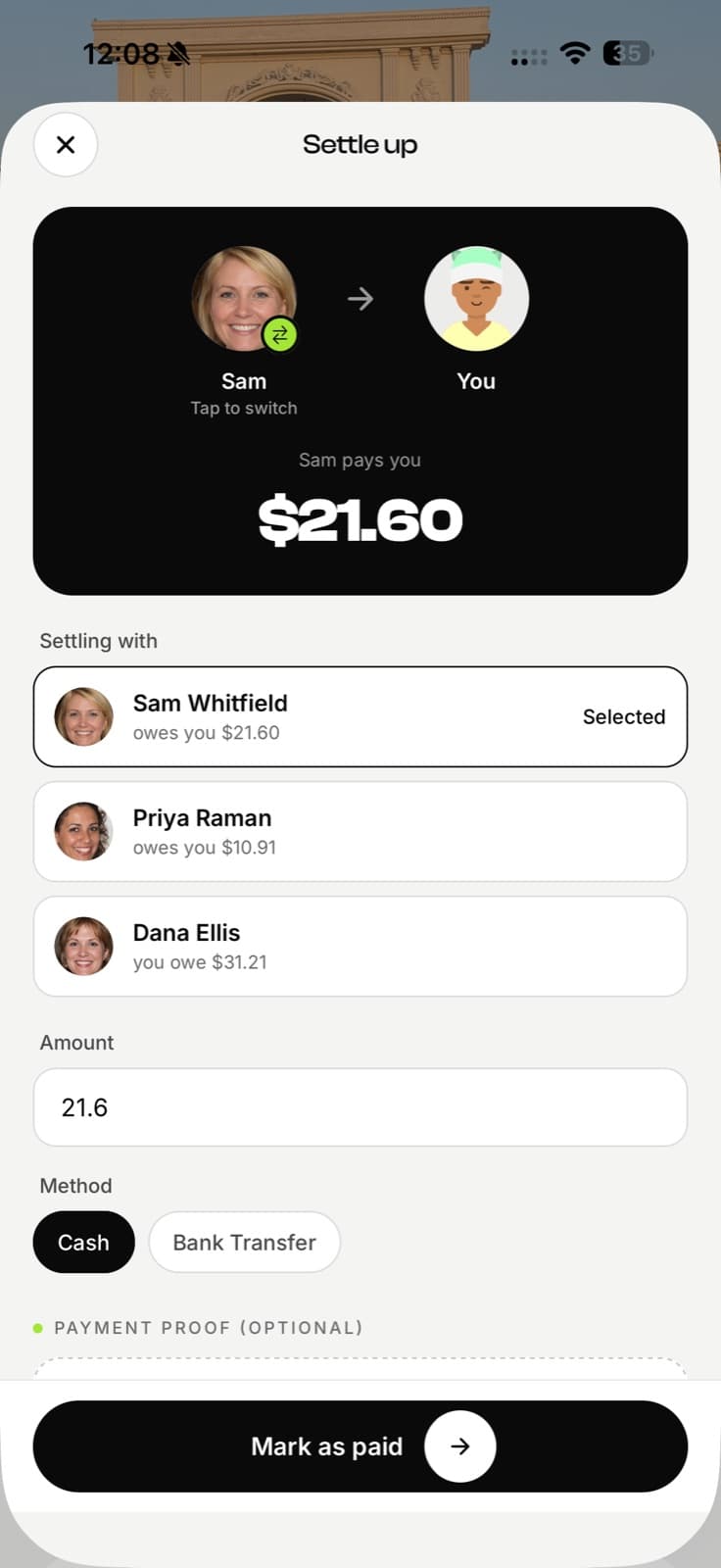
Add the gift as one expense paid by the organiser and split equally among the contributors. Everyone sees exactly what they owe, gets a reminder, and marks it paid when they transfer. The organiser sees at a glance who has paid, without sending a single 'just checking' message. Payment proof screenshots can be attached when settling up.
For collecting money for something bigger, a trip or a party, see how to split bachelor and bachelorette party costs and running a shared fund that stays honest.