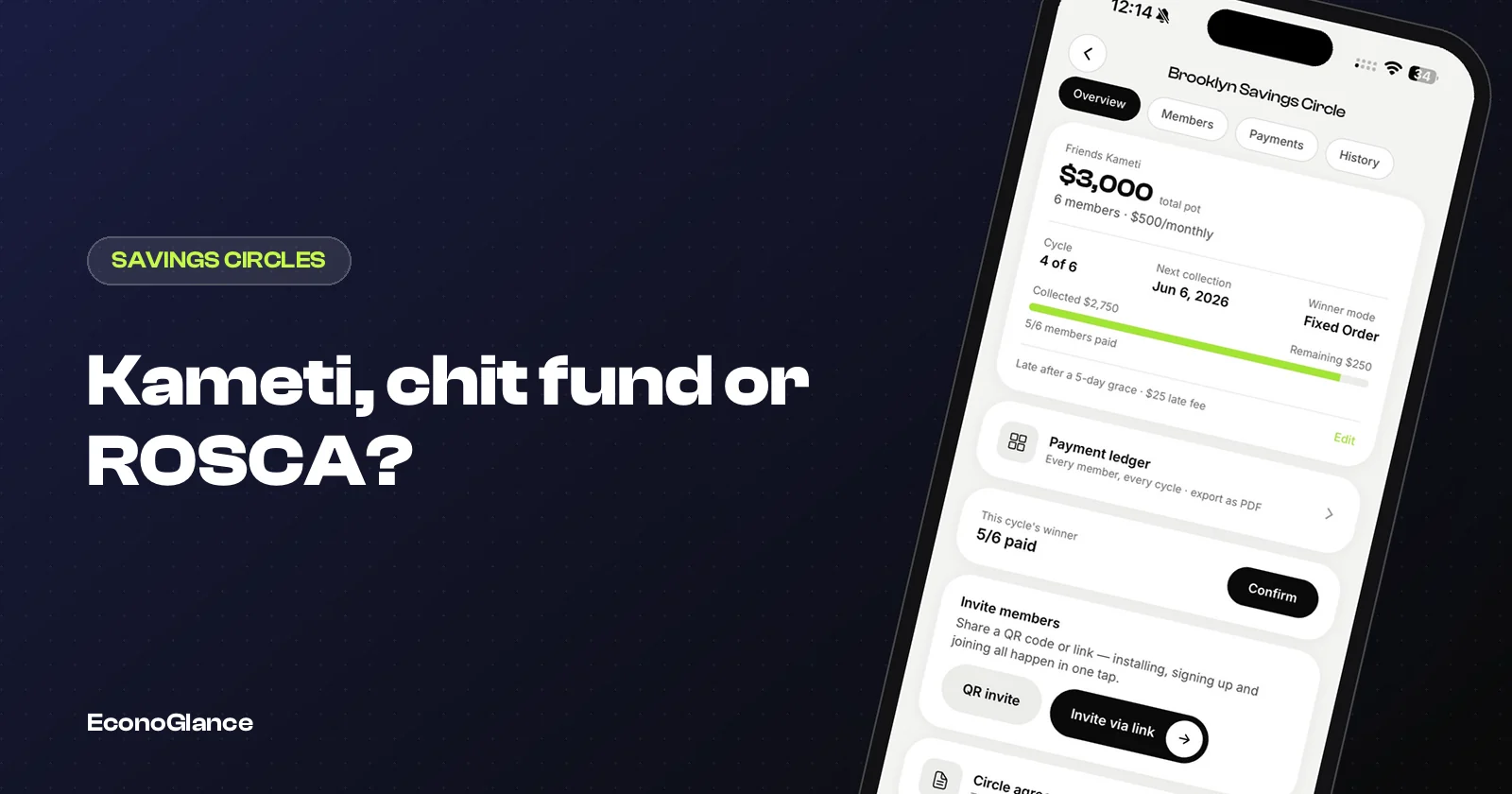
A ROSCA, short for rotating savings and credit association, is a group in which every member contributes a fixed sum at regular intervals and the combined pot goes to one member each round until everyone has received it. A kameti is Pakistan's name for an informal ROSCA. A chit fund is India's regulated, commercial version. They share one mechanism and differ in who runs them, what rules apply and what they cost.
Researchers have documented ROSCAs on every continent, under dozens of local names. The full list, from tandas in Mexico to stokvels in South Africa, is on our page about savings circles around the world. This guide focuses on the three terms people in South Asia and the diaspora most often confuse.
At a glance
The short version, before the detail.
| ROSCA | Kameti (Pakistan) | Chit fund (India) | |
|---|---|---|---|
| What it is | The general concept | An informal ROSCA among people who know each other | A registered business running ROSCAs |
| Who runs it | Varies | A member, usually the organiser | A licensed foreman |
| How the pot is allocated | Varies | Fixed turns, draw, or sometimes bidding | Auction, where members bid a discount |
| Fees | Varies | Usually none | Foreman commission, capped at 7% of the chit amount |
| Regulation | Depends on country | No specific licensing for small private groups | Chit Funds Act 1982, amended 2019 |
| If something goes wrong | Depends | Social pressure, mediation, ordinary courts | A regulator and the Act's procedures |
ROSCA: the umbrella term
ROSCA is the term economists and anthropologists use for the whole family.
It exists because the same arrangement appears independently in very different societies. People who cannot easily borrow, or who want enforced saving, pool money with people they trust. Research going back decades describes the same basic rules everywhere: fixed contributions, a fixed group, rotation until everyone has been paid.
What varies is allocation. Some ROSCAs use a fixed order, some a random draw, some bidding. Economists have studied that choice in detail, and the short answer is that random allocation works best when members' needs are similar, and bidding helps when they differ.
Kameti: Pakistan's informal ROSCA
A kameti, also called a committee or BC, is run by and for people who know each other: family, neighbours, colleagues.
There is usually no fee. The organiser does the collecting and recording for free, sometimes taking an early turn in return. Turns are decided by agreement or by a draw. Bidding exists but is less common in Pakistan than in India's chit funds. The agreement is often verbal, which is both the kameti's strength, since it is fast and flexible, and its weakness, since memories differ.
For how a kameti runs end to end, read the kameti guide and BC committee explained.
Chit fund: India's regulated version
A chit fund in India is a business. A foreman, who must be registered, organises the group, collects contributions and conducts an auction each month.
In the auction, members who want the pot bid a discount. The winner takes the pot minus the discount, the foreman takes a commission, and the rest of the discount is shared among the members as a dividend. India's Chit Funds Act of 1982 governs all of this. Its 2019 amendment raised the foreman's maximum commission from 5% to 7% of the chit amount, raised the limits on how much individuals and firms can run, and allowed members to join the draw by video conference.
Registration gives members something a kameti does not: a regulator and a legal procedure if the foreman fails. It also costs money in commission, and an unregistered operation calling itself a chit fund gives you none of the protection. Check registration before joining.
The chit fund guide covers the auction and dividend mechanics in full.
Which is safer?
Neither form removes the core risk of any ROSCA: a member who receives the pot early and stops paying.
| Risk | Kameti | Registered chit fund |
|---|---|---|
| Member default after payout | Absorbed by the group or organiser | Handled by the foreman under the Act |
| Organiser or foreman disappears | Little formal recourse | Regulatory and legal recourse |
| Hidden costs | Rare | Commission is a known cost |
| Flexibility | High | Lower, bound by the Act's procedures |
The practical rule is the same for both. Join groups run by people or firms you can verify, put members you know less well later in the order, and make sure every payment is recorded where every member can see it.
Which should you use?
It depends on where you live and who you are saving with.
- Saving with family or close friends: a kameti. No fees, and trust does most of the work.
- In India, saving with people you do not know well: a registered chit fund, accepting the commission as the price of protection.
- In the diaspora: the local ROSCA tradition of your community, with written rules.
Tracking any of them in EconoGlance
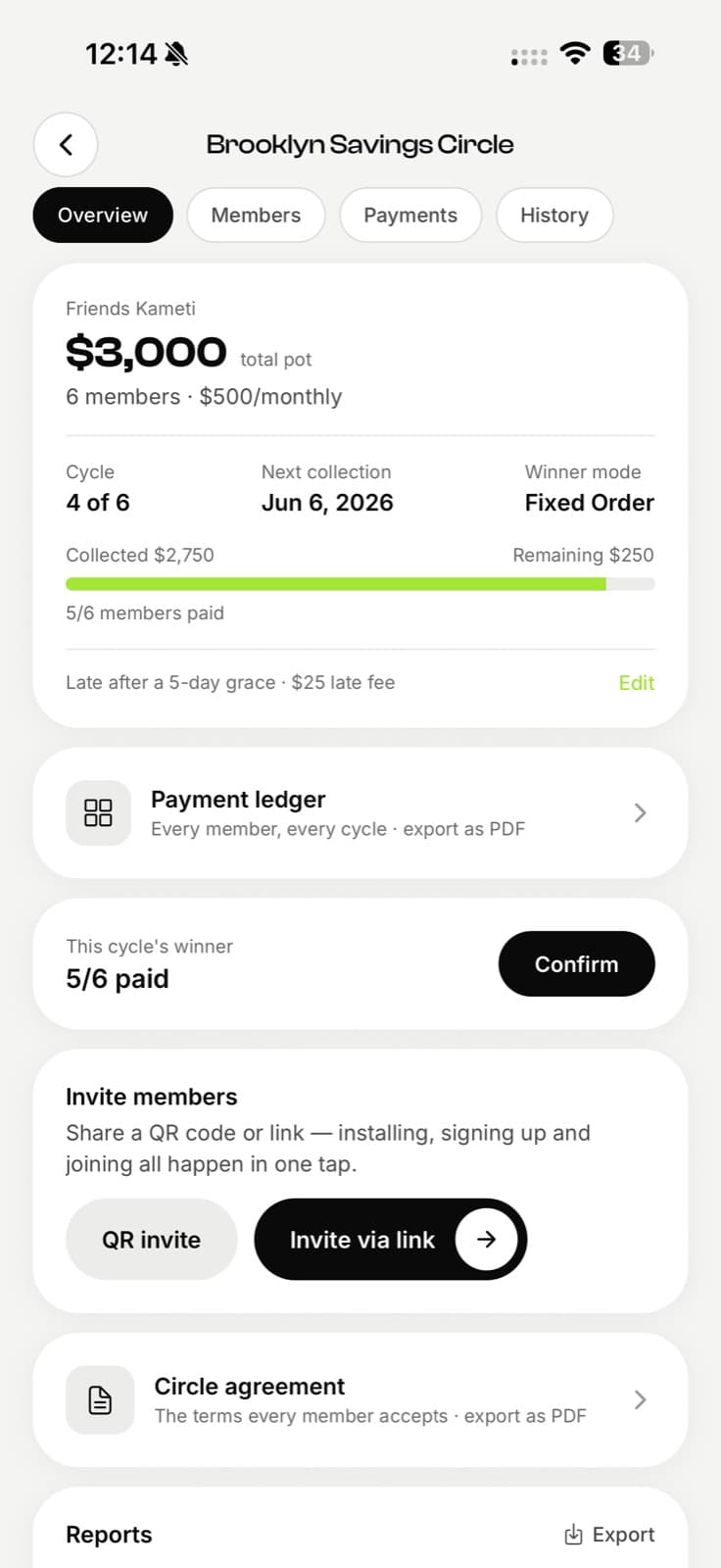
EconoGlance's kameti feature tracks the informal kind: a group you organise yourselves.
It records the agreement, the payments and the turn order for every member to see, with fixed order, draw, manual, quiz and emergency-priority allocation. It does not run auctions or act as a foreman, and it is not a substitute for a registered chit fund's legal protections.
See every name for the same idea on savings circles around the world, and model a pot with the savings circle calculator.