Flatmates in Dubai usually split four things: the annual rent, the DEWA bill for electricity and water, the district cooling or chiller bill, and the deposits paid when moving in. Rent and fixed charges are best split by each person's rent share. Usage-based charges are usually split equally. The detail that catches people out is that the DEWA bill carries the Dubai Municipality housing fee, which is calculated from the rent, so it should be shared the same way the rent is.
Before anything else, make sure your tenancy contract and building rules allow the number of people who will live in the flat. This guide is about splitting costs, not about tenancy rules, which you should check with your landlord or agent.
Rent paid by cheque
Dubai rent is commonly paid in one to four post-dated cheques for the year, which means one flatmate usually writes them all.
That person is then owed money for the whole year by everyone else. The simple fix is a monthly transfer from each flatmate to the cheque-writer, on a fixed date, regardless of when the cheques clear. If you want the person writing the cheques to carry less risk, ask flatmates to pay a month or a quarter in advance.
If rooms differ in size, split the rent by room rather than equally. The method and a calculator that works in AED are in how to split rent by room size.
The DEWA bill and the 5% housing fee
A DEWA bill for a rented flat has two quite different parts.
- Electricity and water consumption, which depends on use.
- The Dubai Municipality housing fee, 5% of the annual rent registered in Ejari, charged in 12 monthly instalments on the tenant's DEWA bill.
Example: annual rent of AED 120,000 means a housing fee of AED 6,000 a year, or AED 500 a month on the DEWA bill. If one flatmate pays 40% of the rent and two pay 30% each, the housing fee should be split 40/30/30 as well, AED 200, AED 150 and AED 150 a month. Splitting the whole DEWA bill equally quietly makes the people in smaller rooms subsidise the larger one.
| DEWA bill part | Monthly (example) | Split |
|---|---|---|
| Electricity and water | AED 450 | Equally, or by use if very uneven |
| Housing fee (5% of annual rent of AED 120,000) | AED 500 | In proportion to rent shares |
Opening a DEWA account for an apartment also needs a refundable security deposit, AED 2,000 for an apartment and AED 4,000 for a villa, plus a non-refundable activation charge of about AED 130. Record who paid the deposit. It comes back when the account is closed, and it should go back to whoever paid it.
Chiller charges: the fixed part and the usage part
Many Dubai buildings use district cooling, billed by a provider such as Empower rather than by DEWA. Some flats are chiller-free, with cooling included in the rent. Check which yours is before you sign.
Where you pay for cooling, the bill has two parts. Empower, for example, charges a demand or capacity charge of AED 750 per refrigeration ton per year, based on the cooling capacity allocated to the flat and billed monthly whether the AC is on or not, and a consumption charge per refrigeration ton-hour of cooling actually used. A flat allocated 6 refrigeration tons carries AED 4,500 a year in capacity charges before anyone switches the AC on.
| Chiller bill part | What drives it | Fair split |
|---|---|---|
| Capacity or demand charge | The flat's allocated cooling capacity | In proportion to rent shares, like rent |
| Consumption charge | Cooling actually used | Equally, or by agreement if one person runs AC far more |
| Fees and VAT | Follow the parts above | Same as the part they apply to |
Summer bills can be several times winter ones. Agree the split in the cool months, before the first big bill arrives.
Deposits: the money people forget
Moving into a Dubai flat often involves three separate deposits.
| Deposit | Typical amount | Record |
|---|---|---|
| Landlord security deposit | Often around 5% of annual rent for unfurnished flats | Who paid what share |
| DEWA security deposit | AED 2,000 apartment, AED 4,000 villa | Whose name the account is in, who paid |
| Chiller or cooling deposit | Set by the provider | Whose name, who paid |
When a flatmate moves out, the deposits usually stay in place until the whole tenancy ends. The incoming flatmate pays the leaver their share instead. Write that rule down at the start.
Internet, gas and the rest
Most remaining costs split equally.
- Internet: equally, unless someone works from home and asks for a faster plan, in which case they pay the difference.
- Gas, where supplied: equally.
- Maintenance and small repairs: equally, unless someone caused the damage.
- Shared groceries and supplies: from a kitty or in turns.
For a single agreement covering rent, bills, chores and moving out, use the free roommate agreement template.
Tracking it in AED
A Dubai flat generates a predictable set of recurring bills, which is exactly what a shared expense app is for.
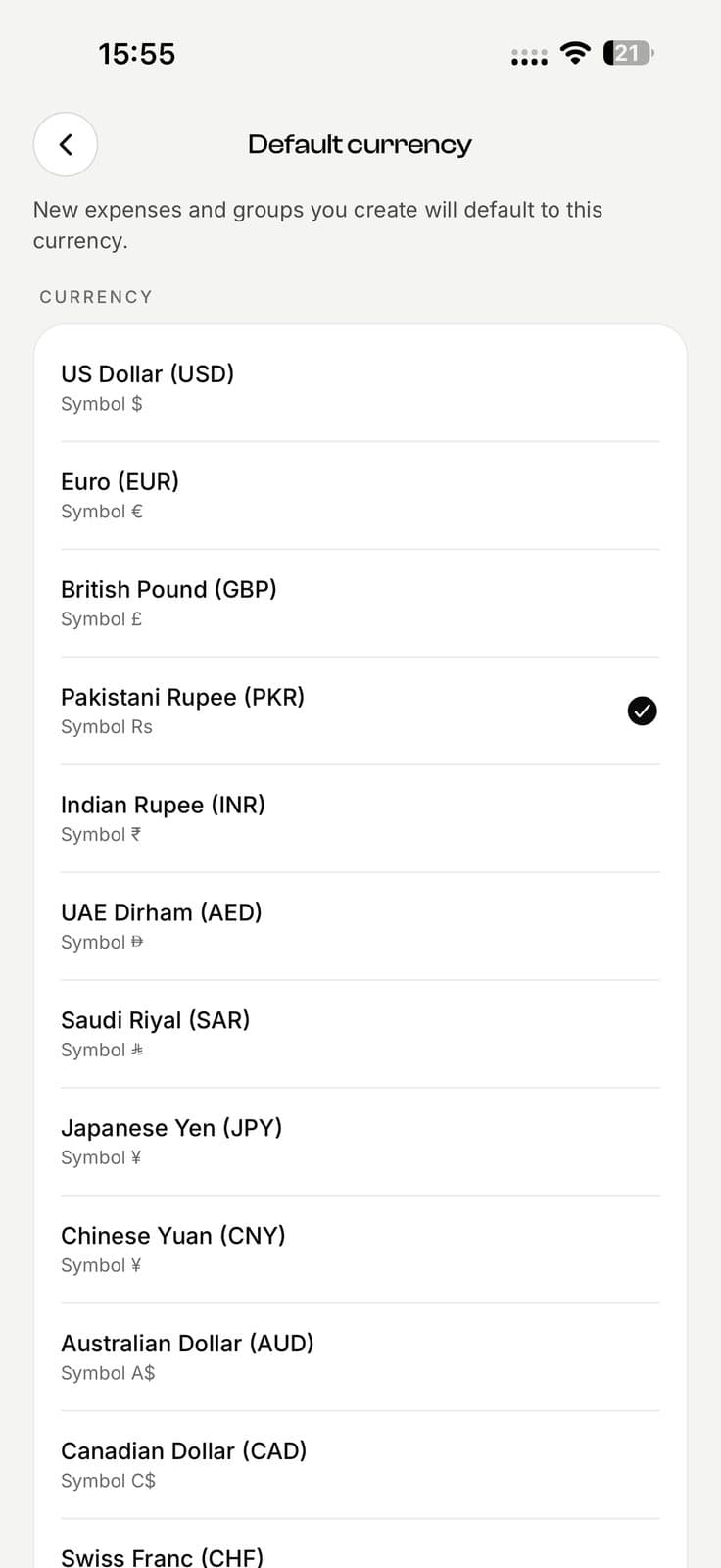
In EconoGlance, set the flat's group currency to AED, add rent as a recurring expense split by exact amounts, and add each DEWA and chiller bill with the housing-fee and capacity parts split by rent share and usage split equally. Balances show who owes the cheque-writer and the bill-payer at any moment, and the free plan covers one group you create.
Sharing a villa in Saudi Arabia instead? Read sharing a villa in Riyadh: how expat housemates split costs.