To split rent by room size, divide the rent into two parts. One part pays for the common space, the kitchen, living room and hallways, and is split equally between every person. The other part pays for the bedrooms and is split in proportion to each bedroom's floor area. The calculator below does both and shows the method under the result.
| Room | Bedroom part | Common part | Pays |
|---|---|---|---|
| Room 1 | $753.49 | $400.00 | $1,153.49 |
| Room 2 | $586.05 | $400.00 | $986.05 |
| Room 3 | $460.47 | $400.00 | $860.47 |
Method: 40% of the rent covers the common space and is split per person. The other 60% is split in proportion to bedroom size. Count an en-suite bathroom or a balcony as part of the room it belongs to.
The method, step by step
Here it is with a real example: rent of $3,000 a month, three bedrooms of 180, 140 and 110 square feet, and a 40% share for common space.
- Common part: 40% of $3,000 is $1,200. Split equally between three people, that is $400 each.
- Bedroom part: the remaining $1,800 is split by size. The rooms total 430 square feet.
- Room 1: 180 ÷ 430 of $1,800 = $753.49. Room 2: 140 ÷ 430 = $586.05. Room 3: 110 ÷ 430 = $460.47.
- Add each person's $400 common share to their room's share.
| Room | Size | Bedroom part | Common part | Pays |
|---|---|---|---|---|
| Room 1 | 180 sq ft | $753.49 | $400.00 | $1,153.49 |
| Room 2 | 140 sq ft | $586.05 | $400.00 | $986.05 |
| Room 3 | 110 sq ft | $460.47 | $400.00 | $860.47 |
| Total | 430 sq ft | $1,800.00 | $1,200.00 | $3,000.00 |
Compare that with an equal split of $1,000 each. The person in the smallest room saves about $140 a month, and the person in the largest pays about $153 more. Both numbers are easy to justify, which is the point.
Choosing the common-space share
The one judgement call in this method is what share of rent covers the common space.
A flat with a large living room and kitchen, where everyone spends time, justifies a higher common share. A flat where people mostly stay in their rooms justifies a lower one, which makes room size count for more. Most flats land between 30% and 50%.
| Common share | Effect | Suits |
|---|---|---|
| 30% | Room size matters a lot | Big differences in bedroom size, small common areas |
| 40% | Balanced | Most shared flats |
| 50% | Room size matters less | Big shared living spaces, similar rooms |
Agree the percentage before anyone chooses a room. Once people know which room they want, every percentage looks suspiciously convenient to someone.
Adjusting for features, not just size
Square footage is a good start but not the whole story.
- En-suite bathroom or balcony: add its area to the room it belongs to. A 150 square foot room with a 40 square foot en-suite counts as 190.
- A couple in one room: they count as two people for the common part, because they use the kitchen and living room twice as much, but as one room for the bedroom part.
- A noisy room by the street or a room with no window: agree a flat discount, say $50, and spread it across the others.
- Parking, storage or a private entrance: price it separately and charge it to whoever uses it.
When size is not enough: the bidding method
Some groups would rather say what each room is worth to them than measure it.
In the bidding approach each person privately assigns a value to every room, with the values adding up to the total rent. An algorithm then assigns rooms and prices so that nobody would rather swap with anyone else, known as an envy-free division. Researchers Jonathan Goldman and Ariel Procaccia built this into Spliddit, a free fair-division website that ran from 2014 to 2022. It is the most rigorous method, and it works well when rooms differ in ways measurements cannot capture, such as light, view or quiet.
For most flats, the size method is easier to explain and close enough. If your group cannot agree on the common-space share, the bidding method sidesteps the argument entirely.
Bills are a separate question
Room size is a fair basis for rent. It is a poor basis for most bills.
Internet, gas and electricity usually make more sense split equally, or by use when one person clearly uses more. That is covered in how to split utilities when one roommate uses more, and the full set of roommate methods, including splitting by income, is in how to split rent and bills with roommates.
Write it down and track it
Once you have the numbers, put them in writing and record each month's rent in a shared place.
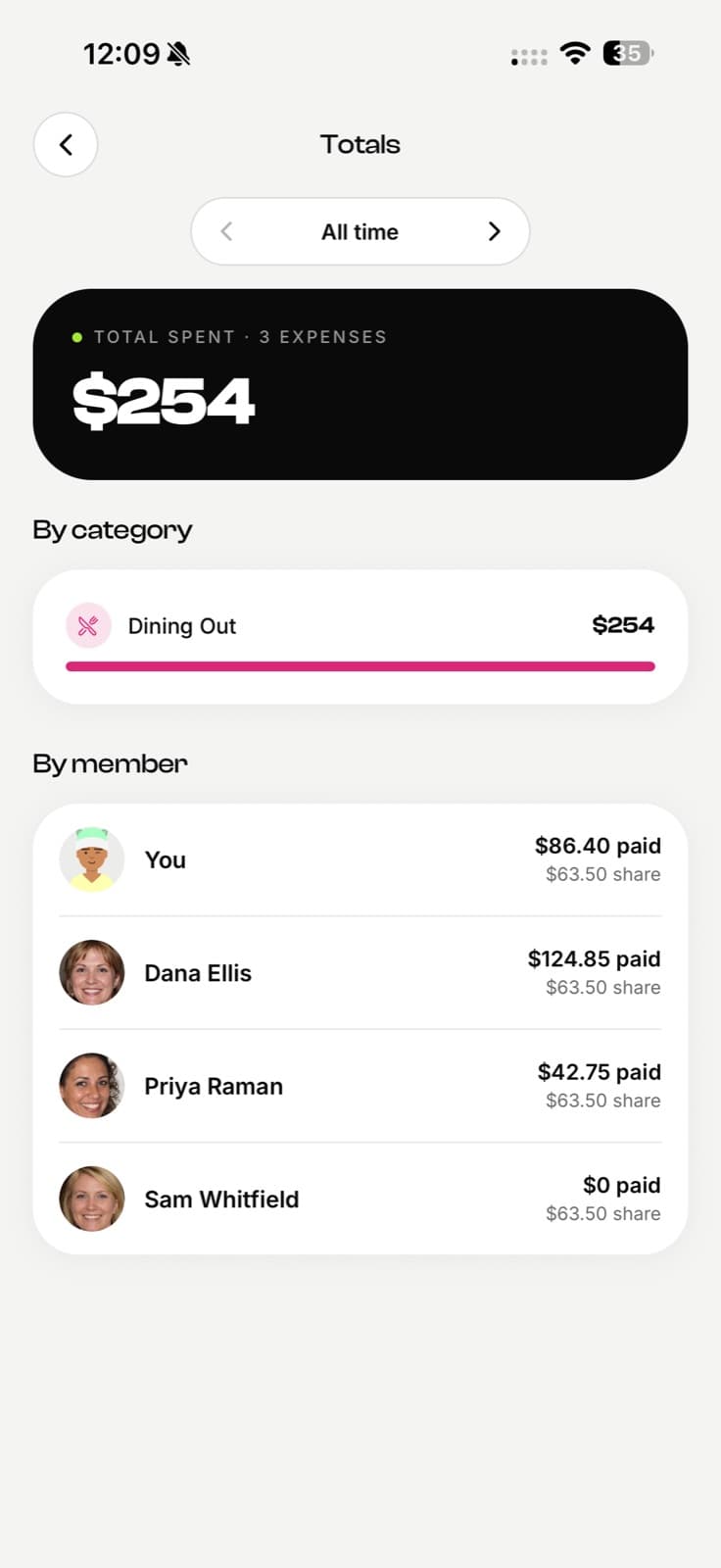
In EconoGlance you can add the monthly rent as a recurring expense in your flat's group and split it by exact amounts, so each person's share matches the calculator. Balances update automatically, and anyone who pays the landlord on everyone's behalf is shown what each flatmate owes.
Put the split and the house rules into the free roommate agreement template so the numbers do not have to be renegotiated every time someone moves.