Co-parenting expenses are the costs of raising a child that separated parents share beyond each parent's day-to-day spending. They usually include medical and dental costs, childcare, school costs and activities. The fairest way to handle them is to agree in writing which costs are shared and in what proportion, record each one with a receipt as it happens, and settle up on a fixed schedule.
This guide is about the practical record keeping. It is not legal advice. If you have a court order or a formal child support arrangement, that sets the rules, and a family lawyer or mediator can help where it is unclear.
Child support and shared expenses are different things
Mixing them up causes most co-parenting money disputes.
Child support, or child maintenance in the UK, is a regular payment from one parent to the other, usually set by a formula. In the US, every state is required to use numeric child support guidelines, and costs such as work-related childcare, health insurance and extraordinary medical expenses are typically added on top of the basic support amount rather than included in it. The UK's Child Maintenance Service similarly sets a regular amount, and parents can also make their own family-based arrangement.
Shared expenses are the extras on top. Keep the two in separate records. A regular support payment should never be netted against a disputed school trip, because then neither record is clear.
What usually counts as a shared expense
Agree the categories once, in writing.
| Category | Examples | Often shared? |
|---|---|---|
| Medical and dental | Uninsured treatment, braces, glasses, prescriptions | Usually |
| Childcare | Nursery, after-school care, holiday clubs | Usually, when work-related |
| School | Uniform, trips, devices, exam fees | Usually |
| Activities | Sports clubs, music lessons, equipment | If both parents agreed in advance |
| Big one-offs | Bike, laptop, school trip abroad | If both parents agreed in advance |
| Everyday costs | Food, clothes and toiletries in each home | Usually not: each parent covers their own home |
The phrase 'agreed in advance' does a lot of work. Most disputes are about an activity one parent signed the child up for and the other heard about from the bill. A simple rule helps: anything over an agreed amount needs a yes in writing before it is paid.
Choosing the split
Two common approaches.
- Equal: 50/50 on every shared expense. Simple, and fair when incomes are similar.
- In proportion to income: if one parent earns 60% of the combined income, they pay 60% of shared extras. Fairer when incomes differ a lot, and close to how many formal guidelines think about it.
Example: Sarah earns $5,400 a month and James earns $3,600. Combined income is $9,000, so Sarah's share is 60% and James's is 40%. A $750 orthodontic bill becomes $450 for Sarah and $300 for James.
The income method, with more examples, is explained in how to split bills by income.
A record both parents can trust
A good co-parenting record has the same few fields for every expense.
| Field | Why |
|---|---|
| Date and description | What it was and when |
| Category | Matches the agreed list |
| Amount and who paid | The basis of the reimbursement |
| Receipt | Removes questions about the amount |
| Agreed in advance? | Yes or no, with a note of how |
| Settled? | Date the other parent reimbursed their share |
- Log the expense within a few days of paying, with the receipt.
- Settle monthly, not item by item. One payment a month is fewer messages and less friction.
- Set a deadline, for example 30 days, for raising a question about an expense.
- Keep the messages about money factual and short. The record does the explaining.
Tone, and why the record helps it
Money is rarely the real issue in a co-parenting dispute, but it is often where the dispute shows up.
A shared record that both parents can see changes the conversation. Instead of 'you never pay for anything', there is a list. Instead of 'I didn't know about that', there is a note of when it was agreed. The record cannot make two people agree, but it removes the arguments about facts and leaves only the ones about decisions.
Tracking it in EconoGlance
A two-person group in EconoGlance works well as a co-parenting record.
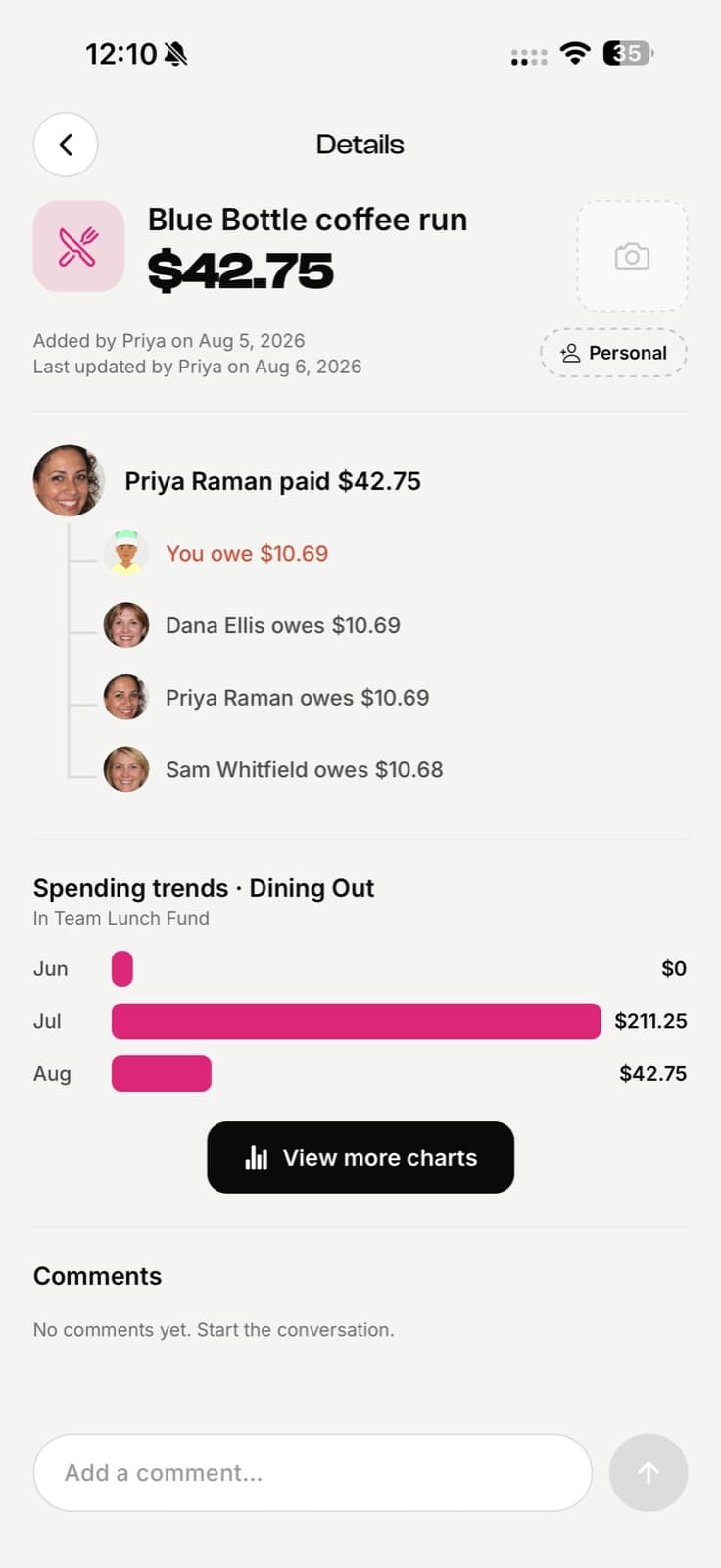
Add each shared expense with who paid it and split it equally or by percentage, so an income-based 60/40 split is applied automatically. Each expense can have a comment thread, so the question and the answer stay attached to the cost. The balance shows exactly what one parent owes the other at any moment, and settling up records the payment. Receipt photos are part of Pro.
If you also need to track which card or account paid for what, see tracking spend across multiple cards, and for settling balances cleanly, who owes who: a practical guide to settling up.