To split the costs of a shared car fairly, separate fixed costs from running costs. Fixed costs, such as insurance, road tax, registration, parking permits and any finance payments, are the same whether the car moves or not, so split them by an agreed share. Running costs, mainly fuel, tyres and servicing, grow with use, so split them by distance driven or by who used the car. Fines and damage are paid by whoever caused them.
Fixed costs and running costs
Every car cost fits into one of two groups.
| Cost | Fixed or running | Fair split |
|---|---|---|
| Insurance | Fixed | Agreed shares |
| Road tax and registration | Fixed | Agreed shares |
| Finance or lease payments | Fixed | Agreed shares, or by ownership |
| Parking permit or space | Fixed | Agreed shares |
| Fuel or charging | Running | By distance or by who drove |
| Tyres and servicing | Running | By distance |
| Repairs from normal wear | Running | By distance, or agreed shares |
| Fines, tolls, parking tickets | Personal | Whoever incurred them |
| Damage from an accident | Personal | Whoever was driving, via insurance |
Splitting fixed costs
Agreed shares are simplest: 50/50 for a couple, or proportions that reflect how much each person relies on the car.
If one person uses the car for a daily commute and the other only at weekends, a 70/30 split of fixed costs can be fairer than 50/50. If incomes are very different, splitting by income is another option. The point is to agree the share once, not to recalculate it monthly.
Splitting running costs by distance
The most accurate method is a simple log of distance driven.
Note the odometer reading when you take the car and when you return it, or keep a shared note of each trip. At the end of the month, split fuel and wear in proportion to distance. If Maria drove 900 km and Sam 300 km in a month with Rs 36,000 of fuel, Maria pays 75%, Rs 27,000, and Sam 25%, Rs 9,000.
A simpler alternative many couples use: whoever drives fills the tank when it gets low. Over a month it roughly evens out to who used it, without any record keeping. It only works if both people really do it.
A per-kilometre or per-mile rate
For an occasional user, a flat rate per kilometre or mile is often easiest.
Work out the car's running cost per kilometre, fuel plus an allowance for tyres and servicing, and charge the occasional driver that rate for their trips. In the US, the IRS business standard mileage rate, 72.5 cents a mile for January to June 2026 and 76 cents from 1 July, covers the full cost of running a car including depreciation. It is a useful ceiling. A rate covering only fuel and wear will be well below it.
Repairs, fines and accidents
Repairs are where shared cars cause the most friction.
- Normal wear, such as brakes, tyres and servicing, is a shared running cost.
- Damage from a specific incident is the responsibility of whoever was driving, usually through insurance, with the excess paid by that driver.
- Speeding fines, parking tickets and tolls belong to the person who incurred them.
- Large repairs that extend the car's life, such as a new gearbox, are shared by ownership share.
Make sure every regular driver is covered by the insurance policy, named if your insurer requires it. An accident with an uninsured driver turns a cost-splitting question into a much bigger problem.
Who owns the car?
Splitting costs is not the same as owning the car.
If one person bought the car and the other contributes to costs, the car still belongs to the buyer. That matters when the arrangement ends. If both contributed to buying it, write down each person's share of the purchase, so that if it is sold, or one person keeps it, the value can be divided fairly.
When one person stops using it
Shared cars outlast many of the arrangements around them.
- Agree a notice period for stopping contributions, for example one month.
- Fixed costs already paid for the year, such as insurance, can be refunded pro rata by whoever keeps the car.
- If the car was bought jointly, the one keeping it buys out the other's share at an agreed value.
If a relationship is ending, the car is usually one item on a longer list. Splitting costs after a breakup covers the rest.
Tracking it
A shared car generates small, frequent costs paid by different people.
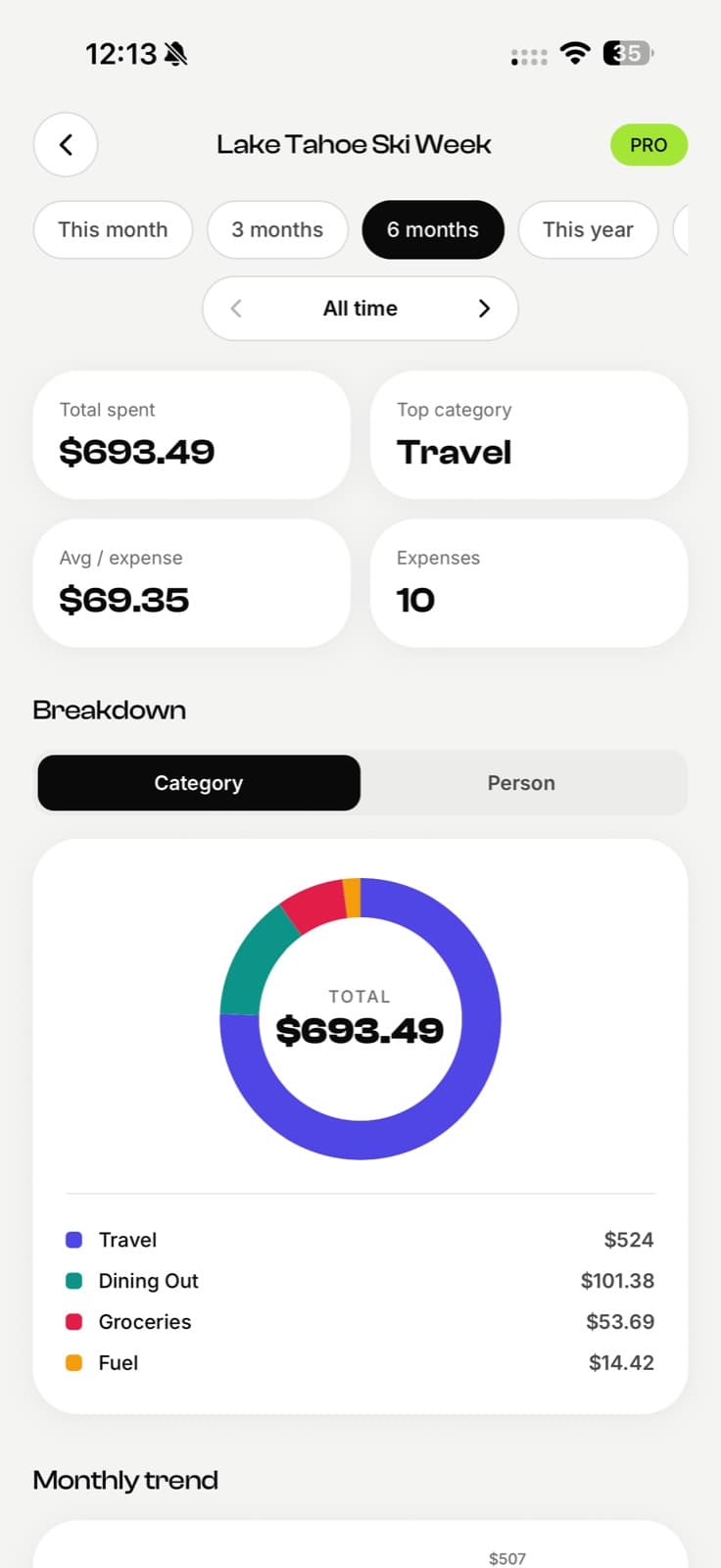
In EconoGlance, create a group for the car, add insurance and tax as recurring expenses split by your agreed shares, and add each fuel stop or repair as it happens, split by distance or by who drove. The running balance shows who owes whom at any moment, so you settle once a month instead of after every fill-up.
For a one-off journey rather than an ongoing car share, use the road trip fuel calculator.