Most Ramadan group costs fall into three settings: iftars hosted at home, iftars at restaurants, and iftars at work. The fairest approach differs for each. Rotate hosting at home, split per head at restaurants, and use a small kitty at work. Ramadan 2027 is expected to begin around 8 February 2027, depending on the moon sighting, so the time to agree the plan is January.
None of this is about turning generosity into accounting. It is about making sure the same family, or the same colleague, does not quietly end up paying for everyone, so that hosting stays something people want to do.
Iftars at home: the hosting rotation
When several households take turns hosting family or friends, a rotation works better than splitting each meal's bill.
- List the households and the dates, and let each pick its evenings early.
- Agree a rough size for each iftar so no host feels pressure to outdo the last one.
- Guests bring something: dates, a dessert or drinks, agreed in advance so there are not six trays of pakoras.
- Larger households host more evenings, or smaller ones co-host together.
A rotation keeps the hospitality personal while sharing the cost over the month. The only thing worth writing down is the schedule. Tracking every host's grocery bill defeats the purpose.
Iftars at restaurants: split per head
Restaurant iftars, especially buffets in the Gulf, are priced per person, so the fair split follows the same logic.
| Item | How to split | Why |
|---|---|---|
| Buffet price | Per head, adults at the adult price | The restaurant charges per person |
| Children | At the children's price, paid by their parents | Families with more children should not be subsidised |
| Drinks outside the buffet | By who ordered them | Often a large share of the bill |
| Service charge | In proportion to each person's share | It is a percentage of the bill |
| Someone's guest of honour | Shared by the rest of the group | Agreed before the booking |
Example: eight adults and three children at an iftar buffet charging AED 150 per adult and AED 75 per child. The adults' share is AED 1,200 and the children's AED 225. A family of two adults and two children pays AED 450. A single guest pays AED 150. Splitting the AED 1,425 total equally over 11 people, or over the eight adults, would both be wrong for somebody.
Iftars at work: a small kitty
Office iftars work best with one collection at the start of the month.
- Agree a fixed amount per person for the month, small enough that nobody feels pressured.
- Make it clearly optional. Colleagues who are not fasting, or who cannot afford it, should not feel singled out.
- One person holds the kitty and shares a simple list of what it paid for.
- Return or roll over any surplus at the end, and say which in advance.
How to keep a kitty honest is covered in detail in the shared fund guide. The same rules apply to an office iftar kitty.
Suhoor, groceries and the household budget
In a shared flat, Ramadan changes the grocery bill.
Flatmates who are fasting often buy more for suhoor and iftar, and those who are not may eat at different times. If you normally split groceries equally, consider splitting Ramadan groceries among those eating the Ramadan meals, or simply agreeing that each person buys their own for the month. Raise it before Ramadan, not during it.
Eid: gifts and gatherings
Eid brings its own shared costs.
- Joint gifts for a parent or grandparent: agree the amount per sibling up front and let one person buy.
- Eidi for children in a large family: some families agree a set amount per child so it is fair across branches.
- An Eid lunch or dinner out: split per head as with iftars.
- Eid travel to family: split fuel and tolls among the people in the car.
For pooling money for a joint gift without chasing anyone, read group gifts: how to collect money without chasing anyone.
What should never be split
Some Ramadan spending is personal by its nature.
Zakat, sadaqah and fitrana are acts of worship and are not a group expense. Do not split them, do not put them in a shared app, and do not let a group record show who gave what. If a group of colleagues or friends wants to give together, for example sponsoring iftar at a mosque, collect it privately, without a public list of amounts.
Keeping track without making it awkward
The goal is a record quiet enough that nobody notices it.
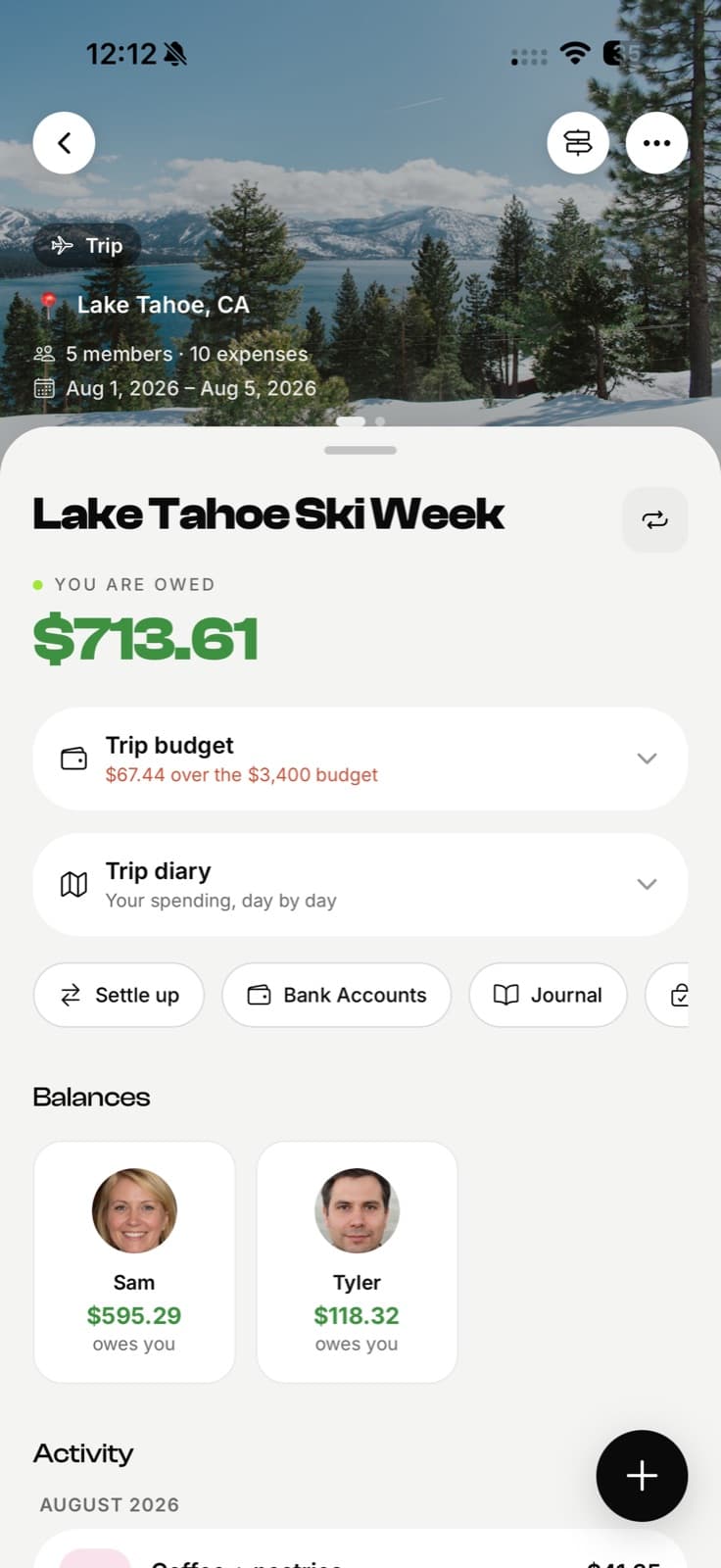
In EconoGlance, create a group for Ramadan, add restaurant iftars as they happen with each family's share, and add the office kitty contributions in one go. Balances at the end of the month show who owes whom, settled in one payment each. The group can be split per head, by exact amounts for families with children, or equally, expense by expense.
For restaurant bills more generally, how to split a bill fairly covers five methods with a worked example.